Project Overview
The limited availability of clean water and the lack of customer awareness of daily consumption patterns often lead to unexpected spikes in monthly bills. This project develops an efficient and independent water usage monitoring system to provide real-time consumption information and transparent cost estimates to customers. Its main focus is to create a reliable solution without full dependence on stable internet, in order to promote wiser and more sustainable water management in urban areas.
System Architecture
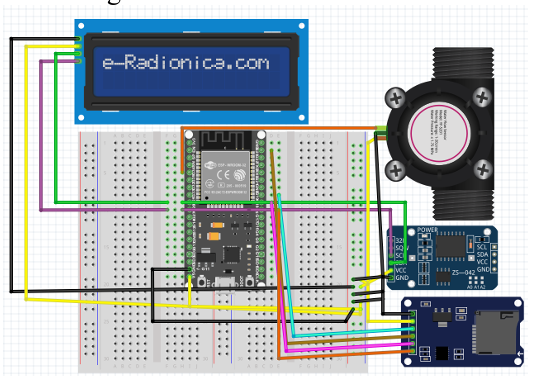
ESP32 Microcontroller
Functions as the main processing unit that processes data from sensors with high speed and stability.
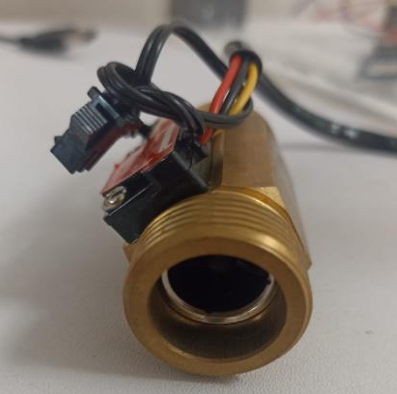
YF B6 Sensor
Detects water flow and sends electrical pulse signals representing the volume of water passing through.
DS3231 RTC Module
Records water usage time precisely for chronological data logging without requiring an internet connection.
SD Card Module
Stores all consumption data history and usage time in a structured manner for the long term.
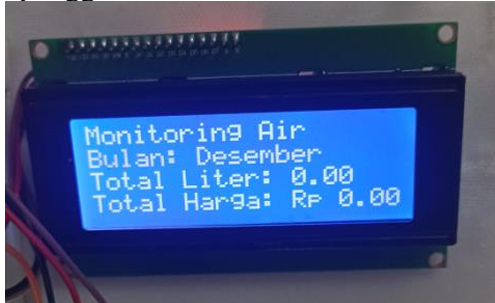
4x20 LCD Screen
Presents visualization of water volume data, price estimates, and usage time directly to the user.
Key Features
Real Time Monitoring
Tracks water volume and usage cost estimates simultaneously through IoT integration.
Offline Data Logging
Time recording and data storage continue to operate stably even without an internet connection.
Leakage Detection
Able to help users detect water leaks through continuous flow monitoring.
Cost Management
Provides cost estimates based on PDAM rates to encourage budget usage efficiency.
System Flow
Data Acquisition
YF B6 sensor detects water flow and sends pulse data to ESP32 microcontroller.
Data Processing
ESP32 converts pulses into volume liters and calculates cost estimates based on applicable rates.
Time Synchronization
RTC module embeds an accurate timestamp on every detected water usage activity.
Data Storage
Information on volume, cost, and time is stored on an SD Card as an archive of usage history.
Information Display
Processing results are displayed in real-time on an LCD screen for easy understanding by users.
Project Outcome
This project produces a water monitoring system that can accurately and transparently record volume and costs. Testing shows the system is reliable in logging data and providing quick responses through the LCD screen. Its main impact is the increased efficiency of water management at the household level and support for efforts to conserve clean water resources.
Screenshots